
Your Adolescent Dog: Learning Together
One-to-one work that takes you from dreading the walk to looking forward to it.
Going for walks was a nightmare and filled me with anxiety… A couple of months down the line and he is almost like a different dog.
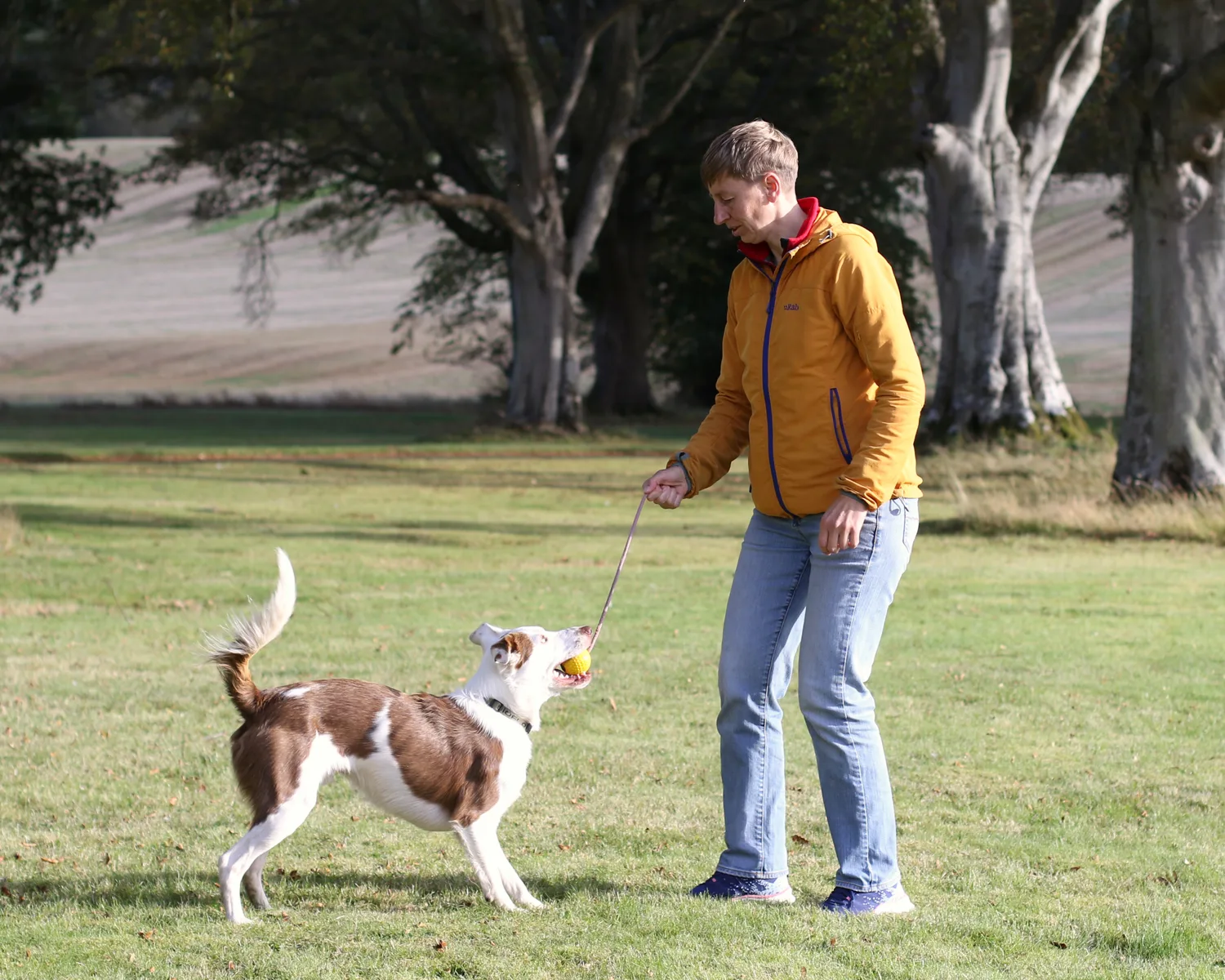
You are not trying to impress anybody. You want to get through a walk without your shoulder hurting. You want him to come back the first time. You want to see another dog coming and not have to make a decision about it.
And you want to stop feeling like the problem is you.
This is a short, concentrated block of one-to-one work, built for exactly this stage of your dog’s life. We work on your routes, with your distractions, on the things that are actually going wrong, not on a list of exercises somebody wrote for a dog that is not yours.
By the end of it you will know what you are doing and why, and your dog will know what you are asking.
We start with whatever is causing you the most grief and sort that first. The training itself is positive and motivational, using food, toys and games to get your dog choosing to work with you rather than being made to. Most owners are surprised by how much they end up enjoying it, but that part is a bonus rather than the point.
What the programme includes
Sessions out in the real world
Not in a hall or a training field. We work where the problems actually happen, so what you learn holds up on a Tuesday morning when I am not standing next to you.
Me working with your dog, not just talking at you
I will handle him myself and show you what he is capable of, then hand him back and coach you through doing it. It is faster, and it is the thing that makes owners believe it is possible.
Sessions close together
We meet more often than a traditional weekly lesson. An adolescent dog changes week to week, so nothing is left long enough to slip, and you are never sitting for days wondering if you are doing it right.
Videos of the exercises we cover
Videos of what we are working on, to watch back in your own time and keep for reference. Some are ones I have made before and use often, others I will film for your dog where it helps. Either way you get the ones that match what you are actually working on, not a generic pack.
Written plans and handouts
Plans, handouts and resources to keep, sent whenever there is something worth having in writing. Not paperwork after every session, but the things you will want to look back on in six months when something new comes up.
Unlimited support between sessions
Email, phone, Messenger or WhatsApp, whichever suits you. If something happens on a Tuesday afternoon that worries you, you message me and we sort it. You do not sit on it until the next session.
The right kit, found for you
If you need a particular harness, lead or toy, I will find the right one and send you the link, so you are not standing in a shop guessing.
What owners say
We first worked with Agata when Murdo was a puppy, and her help and guidance have been invaluable as he's grown into a lively cocker spaniel.
She's incredibly experienced, knowledgeable and approachable, and has helped us successfully tackle challenges including self-control, pulling on the lead, recall and jumping up.
What makes her particularly brilliant is that she doesn't just help address behaviours. She helps you understand your dog and gives you practical strategies and the confidence to continue building on what you've learned.
As Murdo moves through adolescence into early adulthood, we're still putting her advice into practice, with fantastic results.
We couldn't recommend her highly enough, particularly to anyone navigating the joys and challenges of living with an adolescent dog!
Wendy and MurdoCocker Spaniel, Glencarse
I have a 16 month old border collie, Frankie, and we have been working with Agata since he was 10 months old. The problems I was facing were pulling on the lead, reactivity on the lead when passing strangers and other dogs. His recall was also a problem. This made going walks a nightmare and filled me with anxiety. I tended to stick to places where we wouldn't normally encounter dogs or humans but didn't feel that was good for either of us.
I reached out to Agata as I knew I wouldn't be able to resolve these problems on my own. Agata is very knowledgeable, experienced and easy to talk to. Within a few meetings there was a vast difference in Frankie and my confidence grew. However, as he was going through adolescence, just when we thought things had calmed down they came back with a vengeance. As well as the reactivity with strangers, with people he knew he would get extremely hyper.
Anyway, a couple of months down the line and he is almost like a different dog. Much calmer, walks fairly well on the lead, his recall is pretty good and his reactivity, although it can still be there, I have learnt from Agata how to avoid. Frankie is now my best friend and I can't imagine life without him. I will still keep up the training with Agata but won't have to meet so regularly. I would highly recommend Agata, especially if you are having problems with your adolescent dog.
Eleanor and FrankieBorder Collie, Kinfauns
Questions owners ask
My dog is reactive. Is this for him?
Yes, I have successfully worked with reactive dogs for over a decade. But I take only a small number of reactivity cases at any one time, so that each of them gets what they need. Tell me about him when we speak and I will be straight with you about whether I am the right fit.
Can I bring a younger dog?
Yes, and the earlier the better. A lot of what owners come to me about at ten months could have been headed off at four. If your puppy is still young we can put the groundwork in now, build the engagement and the self control early, and give you a much easier adolescence when it arrives. I keep only a small number of spaces open at any one time, so it is worth asking sooner rather than later.
Is it too late? He is already well past seven months
Adolescence lasts a lot longer than most people realise, and this work is just as effective at eighteen months as it is at eight. Earlier is easier, but later is far from hopeless. I have never met a dog it was too late for.
I have already tried a trainer and it did not work
Most of the owners who come to me have. Usually what went wrong was advice built for puppies, or for settled adult dogs, applied to a dog in the middle of adolescence. Different stage, different dog, different approach.
How much do I have to do myself?
A fair amount, and I would rather say so now. There are no quick fixes. I will do as much as I can, but he is your dog and you are the one he lives with. What I can tell you is that most owners end up wanting to carry on, because once your dog starts answering you it stops feeling like work.

I work on my own and I see my clients often, which means I can only take a few people at a time. If you have been putting this off, it is worth asking now rather than waiting for a better week, because the longer an adolescent dog practises something the better he gets at it.
Request a call back and tell me about your dog. There is nothing to prepare. I will ring you when it suits you, tell you honestly what I think, and you decide from there.